
Problem Situation
Before the LLM era, I had questions in high school but could not formulate them clearly, so I ended up lost in a maze. What should I do if a problem does not provide the probability of an intersection or a conditional probability, and only tells me that A and B are dependent?
Can the intersection probability of dependent events be found without additional information?
That’s a good question! Let’s look at what to do if a problem only tells us that A and B are dependent, without providing the intersection probability or conditional probability.
1. Basic Problem Situation
Let’s assume that a problem provides only the following conditions.

In this case, can we find the intersection probability P(A ∩ B)?
2. Why P(A ∩ B) Cannot Be Found Without Additional Information
The formula we can use is:
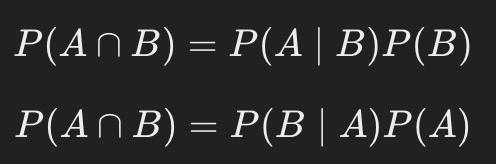
However, if we do not have P(A | B) or P(B | A), we cannot use this formula.
In other words, it is impossible to calculate P(A ∩ B) without additional information.
💡 By analogy
This is similar to trying to calculate “the probability that two people are friends when one person is A and the other person is B.” We know that A and B influence each other (they are dependent), but without knowing how much they influence each other (the conditional probability), we cannot determine the exact probability.
3. Solution: Find Additional Information
So what should we do in this situation?
We need to obtain the following kinds of additional information.
(1) Look for clues in the problem that can be used to derive a conditional probability
- In some cases, there may be hidden information in the problem.
- For example, if the problem includes a clue such as “if A occurs, B is twice as likely to occur,” we can convert it into a conditional probability.
(2) Use experimental data or statistical information
- In real life, it is often difficult to calculate an intersection probability directly.
- Therefore, we can collect data through experiments and then estimate the conditional probability using empirical probabilities.
- For example, we can analyze past data on the two events A and B to approximate P(A | B) or P(B | A).
(3) Use Bayes’ theorem
-
If we know the prior probability P(B) and the probability P(B | A) that B occurs when A occurs,
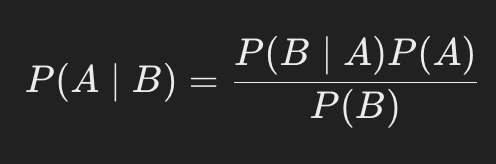
We can use the formula to find the necessary conditional probability and then use it to determine the intersection probability.
4. Conclusion: The Probability Cannot Be Found Without Additional Information
✔ The information that A and B are dependent alone is not enough to find P(A ∩ B).
✔ Additional information such as P(A | B) or P(B | A) is required.
✔ You need to look for hidden clues in the problem, and you can also use experimental data or Bayes’ theorem.
Do you understand it clearly now? 😊
If you have any additional questions, feel free to ask anytime!