Conclusion
- Since we don’t know what kind of parameters options such as
**kwargand*argare, you should use keyword arguments that identify them by name. - For keyword arguments, you must assign values after declaring the method or function and its arguments.
Whether something is a positional argument or a keyword argument is determined when passing parameters to a function or method:
-> whether you assign a value by entering a name and adding =
-> or whether you omit it and assign only values in order
Confusing points
-> Just because a default value was provided in the original function does not automatically make it a keyword argument!
-> Just because = is present does not automatically make it a keyword argument!
Question
- Why is it acceptable to put just a variable in some function parameters, while other parameters require a value to be provided?
Background
While creating a code splitter class, I tried to use LangChain’s from_language method, and
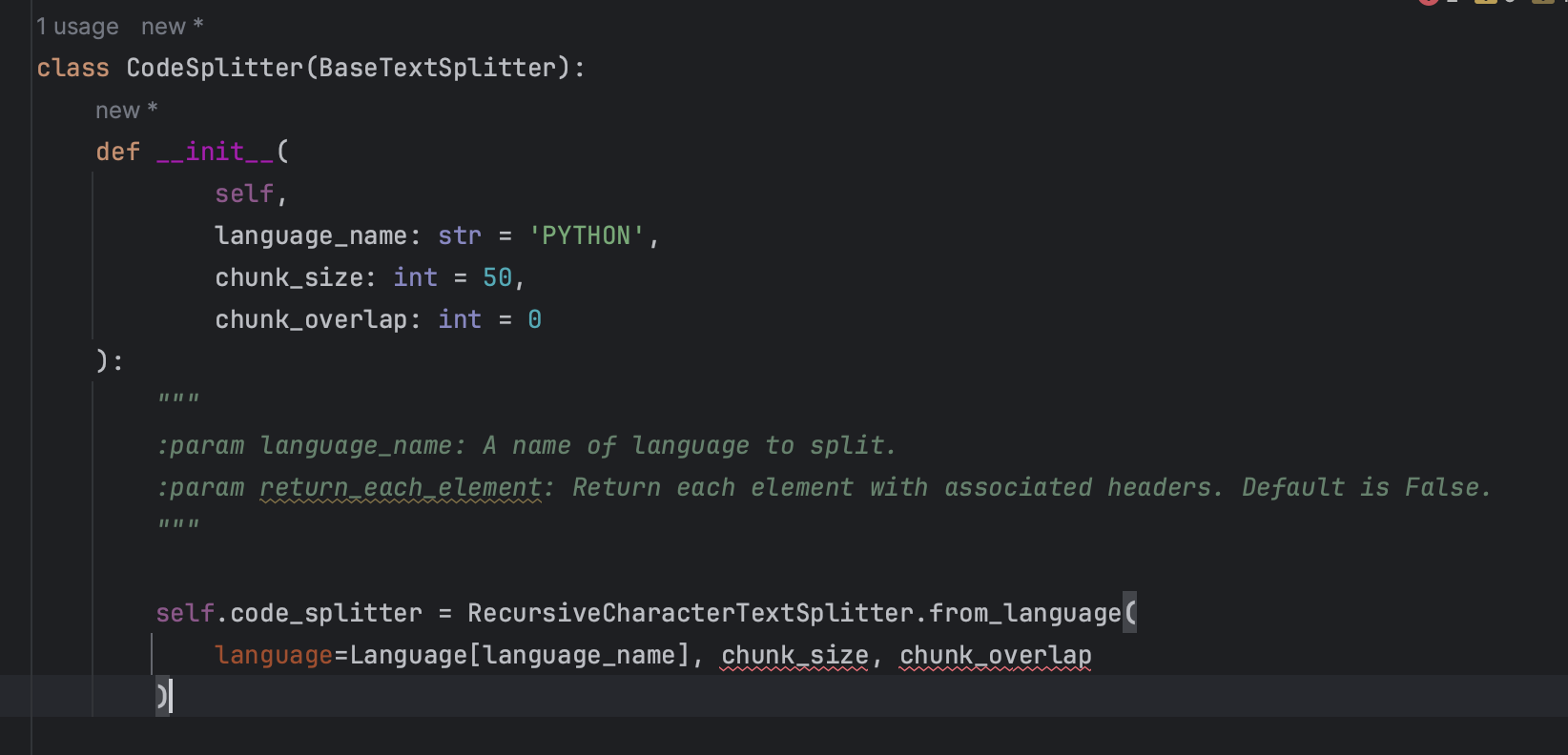
Even though I had clearly set default values for chunk_size and chunk_overlap in the constructor parameters and passed them as they were, I got a positional argument after keyword argument error.
Solution
-
The
chunk_sizeandchunk_overlapshown here are optional arguments represented by**kwarg, so you must use keyword arguments to specify what they are by name. -
Since the
languageparameter was already written first as a keyword parameter, you can either change all the remaining parameters to keyword parameters as well, or move the keyword parameters to the very end so that they do not affect the order of the positional arguments in the original method.
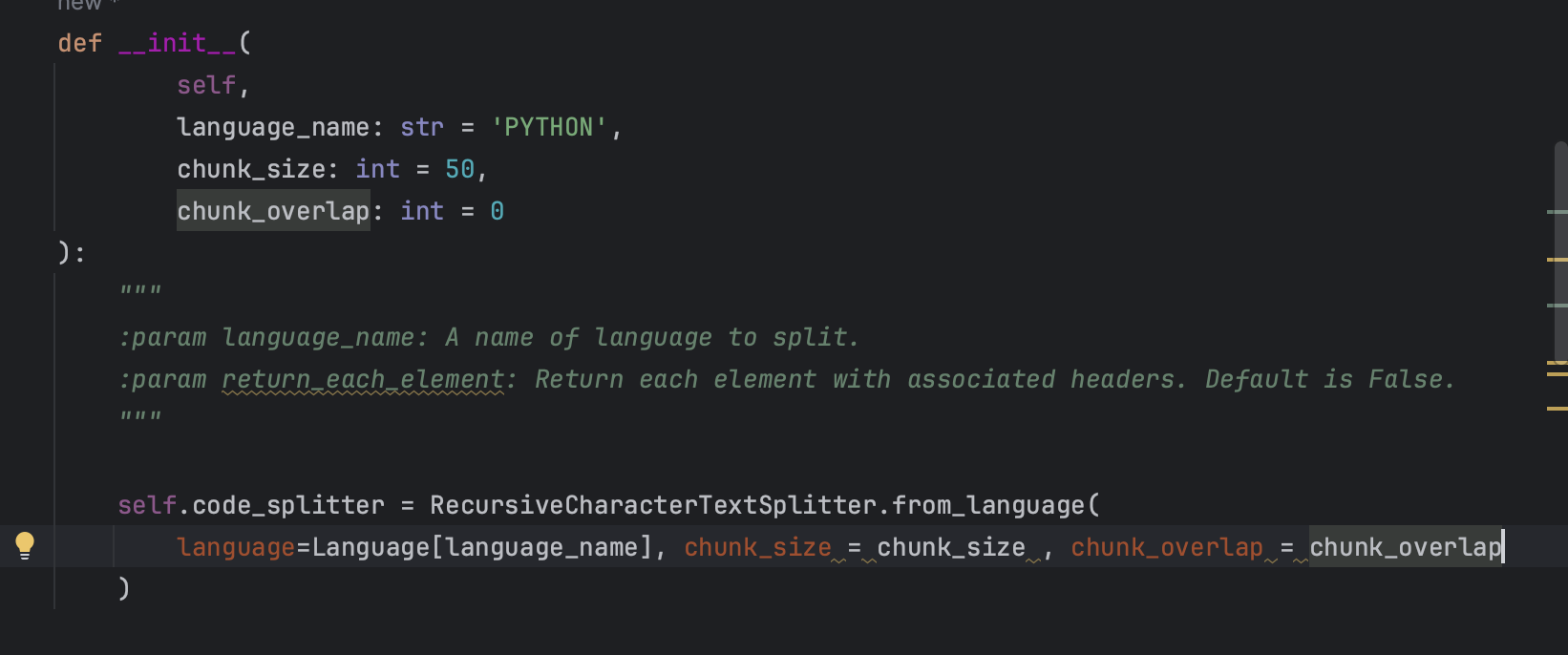 They must be assigned in this way.
Positional Argument
- A part that is set only as an argument in a function
- When calling a function and passing values to its parameters, you must always follow the correct order.
Limitations
- If a function has too many arguments, you may get confused while developing and accidentally pass a value to the wrong place. -> What if we want to create arguments for which the order does not matter? -> Let’s make them findable by name only!
That is exactly what a keyword argument is.
def student_info(name, sex, age) :
  print(f"""
  이름 : {name}
  성별 : {sex}
  나이 : {age}
  """)

>>> student_info("고길동", "남자", 50)
이름 : 고길동
성별 : 남자
나이 : 50

# 단점 : 순서를 잘못 알면 원하는 결과 값이 나오지 않음
>>> student_info("고길동", 50, "남자")
이름 : 고길동
성별 : 50
나이 : 남자
Keyword Argument
- A form in which the function has
argment = value - When assigning values to function parameters, the order does not matter; you only need to mention the correct name and assign a value.
As in the example below, with def student_info(name, sex, age), you would normally have to assign the parameters in the order name, sex, and age. However, by using keyword arguments like (age = 50, name = “Go Gil-dong”, sex = “male”), you can do so regardless of the order.
>>> student_info(age = 50, name = "고길동", sex = "남자")
이름 : 고길동
성별 : 남자
나이 : 50
Rules
1. What is the rule when mixing positional arguments and keyword arguments whose order does not matter?
Conclusion: If you want to use them together, write the positional argument group first, followed by the keyword argument group.
You only need to avoid examples like the following.
def student_info(name, sex, age= 1, hobby) :
  print(f"""
  이름 : {name}
  성별 : {sex}
  나이 : {age}
  취미: {hobby}
  """)
As shown above, hobby, whose order matters, comes after age, a keyword argument whose order does not matter. If this happens,
 a syntax error occurs.
Why can’t you do this?
If a keyword argument group is inserted between positional argument groups like that, the order-independent arguments get inserted between order-dependent arguments, so the order-dependent arguments that follow no longer have meaningful positions. In other words, it becomes impossible to determine which position they occupy.
2. When setting default values
When defining a function, you must not declare a default-value parameter before a non-default-value parameter. If you declare a default-value parameter first as shown below, a SyntaxError occurs and the function is not declared.
def student_info(age= 10, level) :
  print(f"""
  나이 : {age}
  게임 레벨 : {level}
  """)
> Traceback (most recent call last):
File "python", line 1
SyntaxError: non-default argument follows default argumentThis is because if a default-value parameter is declared first, then when calling the function later, it is impossible to know which parameter a particular input argument is assigned to. Since the default-value parameter may or may not receive an input, it becomes difficult to return exactly the desired value.
-> In that case, when declaring the function, you do not know which parameter the argument being passed will be assigned to.
student_info(50)In code like the example above, you do not know whether the age is 50 or the game level is 50.