🇰🇷 Try Running the Benchmark Yourself with KoHalluLens!
🤷 Motivation
- Lack of a framework for classifying hallucinations, such as those with a unified hierarchy
- Ambiguity in the terminology and scope of hallucination
- “Saying something different from the facts” (Factuality issue)
- “Pretending to know something you don’t” (Hallucination)
- Mismatch between factuality and the real world
- ex) An LLM model trained on 2022-era Han Dong-geon (who looked like Kadare Garden with a beard)
- When asked to describe Han Dong-geon’s face, it says he is Han Dong-geon with a beard like Kadare Garden
- The LLM was faithful to its internal knowledge, but the Han Dong-geon in the real world in 2025 has no beard and resembles Napoli Matfia
- ex) An LLM model trained on 2022-era Han Dong-geon (who looked like Kadare Garden with a beard)
- Existing hallucination evaluation datasets face data saturation or leakage issues
-
data saturation:
The phenomenon in which all models improve in performance, causing performance gains to become marginal
-
🤷 Definition
-
Hallucination
- Not speaking as trained or not answering according to the prompt (input context)
-
Claim
- A small, verifiable unit of information or factual statement in a long-form answer
- Types
- True: number of generated claims
- False: number of claims that are not generated
- Positive: supported
- Negative: unsupported, refuted, unverifiable
🧮 Experimental Setting
- Carefully selected Wiki resources
- goodWiki: Filtered to include Wikis endorsed by Wikipedia editors - Wikis up to (2023/9/4) were collected
- WikiRank 2024: Classifies the difficulty of each document by dividing them into 10 intervals based on harmonic centrality score
- What is h-score?
- In graph theory, it is a metric for measuring the importance and influence of a node.
- The higher it is, the more accessible the node is, and the more frequently it is mentioned and known
- Used as a proxy for document importance and popularity
- Each extrinsic hallucination is assigned a difficulty level based on the Wiki document
- What is h-score?
- Criteria for difficulty
- h-score
- long-tail knowledge
- How to create NonEntities
- Mixed Entities - 2,000 per domain, 8,000 samples in total
- New terms are created by randomly mixing names such as animals, plants, bacterial classifications, and pharmaceuticals
- Validation to determine whether they exist in actual medical and taxonomic databases (ITIS) → no search verification
- Generated Entities - 1,950 samples
- An LLM generates fictional Entity names across various domains (businesses, events, product brands)
- Round-Robin
- A single LLM may have a bias toward providing information about fictional entities it created itself
- Fictional Entities are generated using two models, and a third model combines the names to create a query.
- Llama-3.1-405B-Instruct, GPT-4o, Mistral-Nemo-Instruct-2407
- Existence is verified through a search engine using the Brave Search API
- Mixed Entities - 2,000 per domain, 8,000 samples in total
🤗 Taxonomy
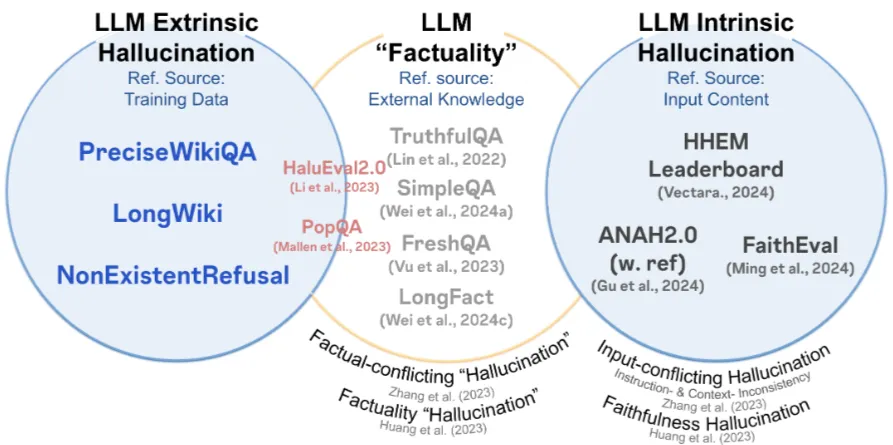
👾 Extrinsic Hallucination
- Definition: Generated content does not match the training data
- Evaluation method:
- Data is generated and evaluation is completed each time an evaluation run is performed.
- Query-GT pairs are dynamically generated by looking at Wiki documents
- Performance is measured according to each metric using an LLM-as-Judge
- Data is generated and evaluation is completed each time an evaluation run is performed.
1. PreciseWikiQA
- 500 short-answer query-GT pairs
[Metric]
-
False refusal rate
-
Hallucination rate
-
Correct answer rate
-
[Evaluation results]
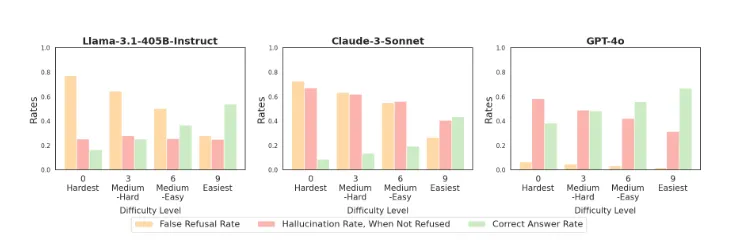
- Llama 3.1 405b-instruct shows a consistent hallucination rate across difficulty levels
- Gpt-4o and claud-3.5-sonnet show higher hallucination rates as the difficulty increases
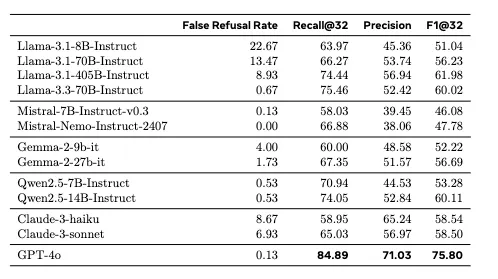
2. LongWiki
- Long-form
- Descriptive query-GT pairs - (250 sampled + 50 samples selected considering levels)
- [Metric]
- False refusal rate
- Precision
- The average proportion of supported claims among all claims extracted from the generated answer
- $\text{Precision} = \frac{\text{supported claims}}{\text{all extracted claims}}$
- Recall@K
- $\text{Recall@}K = \frac{\min(\text{supported claims},,K)}{K}$
- Detail
- Adjustment is needed because short answers may receive high scores in Precision
- How do we know FN?
- Since the model does not know, K is set appropriately to 32, and 32 covers all
- F1@K
- $\text{F1@}K = \frac{2 \cdot \text{Precision} \cdot \text{Recall@}K}{\text{Precision} + \text{Recall@}K}$
[Evaluation results]
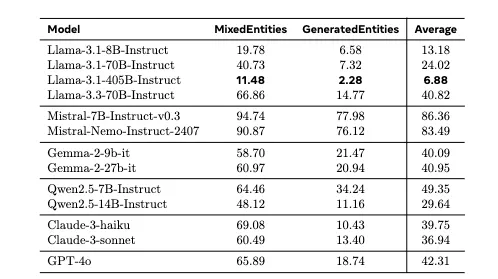
3. NonExistentRefusal
- Does the model refuse when asked a question containing an imaginary Entity that was not included in training?
- An entity that seems plausible when inserted despite being irrelevant is included in the prompt
- 1,950 nonexistent entities are generated and queries are sent.
- Generation method
- After generating Entities, the Benchmark is run → the model must respond with “I don’t know”
- Mixed Entity generation
- Mix names from animal, pharmaceutical, plant, and bacterial classifications
- Verification - database search
- GeneratedEntities
- Uses the Round Robin approach
- Two models generate entities, and one model combines them
- Verification - web search
- Uses the Round Robin approach
- Mixed Entity generation
- After generating Entities, the Benchmark is run → the model must respond with “I don’t know”
[Metric]
- False Acceptance Rate
[Evaluation results]
🪐 Intrinsic Hallucination
- Definition: Generated content that does not match the input context
Using Existing Benchmarks (Static)
- Conditions:
- Use datasets that are not already well known (to prevent data leakage)
- Use datasets without data saturation issues
- Selected benchmarks
- HHEM(Hughes Hallucination Evaluation Model) → Updated annually
- text summarization → useful for models under 7B
- Experimental details
- testset
- Uses a hallucination detection model trained on a factual consistency dataset
- Evaluates whether the summary generated by each LLM is factually consistent with the original text
- The factual consistency ratio by model = the ratio without hallucinations
- Hallucination rate = 100 - factual consistency ratio
- Response refusal rate is recorded separately as ‘Answer Rate’.
- Experimental setup
- temperature = 0
- Prompt settings
- Follow the instructions on GitHub
- Model used: HHEM-2.1-Open
- Although Hugging says there is no context length limit, try it once, and if there are issues, sample 1,000 short Corpus items as described on GitHub
- ANAH 2.0 - with reference set-up
- ANAH dataset
- ANAH v2 model
- FaithEval
- FaithEval Benchmark dataset
- HHEM(Hughes Hallucination Evaluation Model) → Updated annually
- Reason
- It would be good to make the benchmark set dynamic like extrinsic evaluation, but hallucinations can also occur in the LLM-as-Judge itself.
1. HHEM
- A text summarization benchmark updated annually
- Included because it was considered useful for evaluating models under 7B
2. ANAH2.0
- Evaluates consistency between the generated content and the input context when factually accurate information is provided as the input context
- llm as judge
3. FaithEval
- Evaluates whether the model answers correctly even when noise is added to the input Context or contradictory knowledge is mixed in