I am struggling in a military internet café for the Jeju Island traffic volume prediction competition. I wanted to apply as many of the various techniques I had learned as possible. Since the computers at the military internet café can run models only within a limited amount of time, I wanted to try blending, which is somewhat less time-consuming than stacking.
What is blending?
It is one of the ensemble techniques: several weak models are trained on the train data, and predictions are made for the validation set and test set. After respectively concatenating the multiple validation prediction sets and test prediction sets, the concatenated validation prediction set and y_val are used to train a powerful meta-model. The meta-model then makes predictions using the previously concatenated test prediction sets.
How do you do it?
Structure
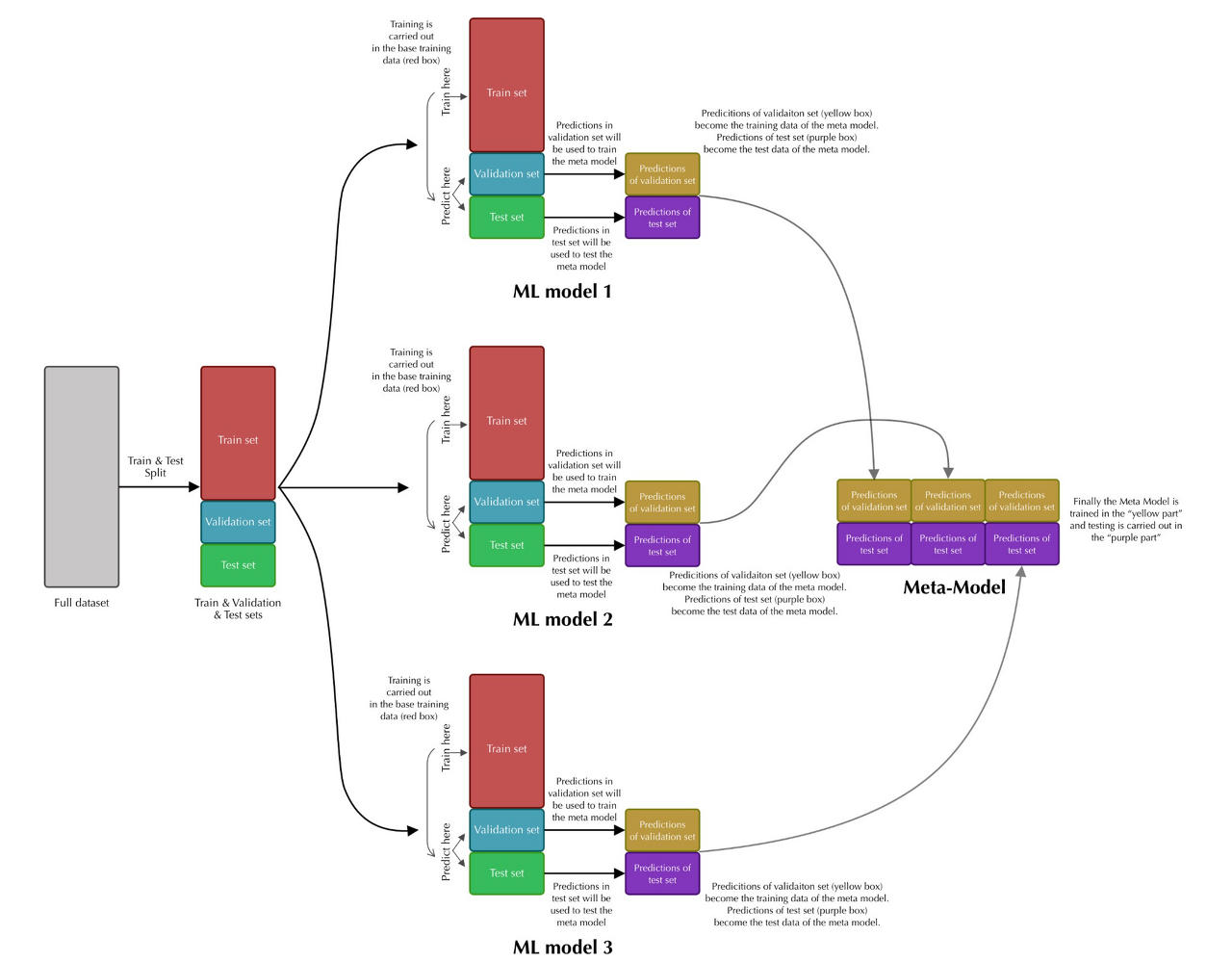
Procedure
- Split the train set into a training set and a validation set using a train-test split
- Train several weak models using the train data
- Use the trained models to predict the validation set and test set
- Respectively concatenate the multiple validation prediction sets and test prediction sets.
cf)
1 - Elements for val when concatenating (the previously split X_val and the byproducts that were predicted)
2 - Elements for test when concatenating (the previously split test and the byproducts that were predicted)
5. Fit the concatenated validation set and y_val to a powerful meta-model.
6. Use the meta-model to predict the previously concatenated test prediction sets.
Nice explanations
https://slowsteadystat.tistory.com/21 https://3months.tistory.com/486 -> In the example code from the second link, it seems that y_test for the score was separated into x_test and y_test from the test set when the train set was initially divided into a validation set and a test set in order to calculate the score.
Source:
- Blending structure image: https://slowsteadystat.tistory.com/21